Wholesale Suppliers Durban: Where to Buy Your Stock
Durban has several distinct wholesale channels rather than one wholesale district. Multi-trader trading centres such as Durban China City suit general merchandise in small quantities; cash and carry wholesalers suit groceries and FMCG; fabric, clothing and trade-counter suppliers serve their own trades; and agents, importers and B2B marketplaces serve larger or specialised orders.
What this guide covers
- The main kinds of wholesale source, and what each is good for
- 1. Multi-trader trading centres
- 2. Cash and carry wholesalers
- 3. Fabric and textile suppliers
- 4. Clothing wholesalers
- 5. Specialist trade counters
- 6. Agents, importers and B2B marketplaces
- If you sell X, start at Y
- Minimum orders: what "wholesale" actually means in practice
- Credit terms, deposits and how you will actually pay
- Delivery, collection and getting the stock home
- How to build a supplier list that actually works
- Frequently asked questions
- Start with one channel and learn it properly
- Related guides
New traders usually ask “where is the wholesale place in Durban?” as if there is one address. There is not. Durban has several separate wholesale channels, each built around a different kind of product, a different minimum order and a different way of paying. Once you can tell them apart, sourcing stops being guesswork.
The short version: general merchandise in small quantities, today, means a multi-trader trading centre such as Durban China City. Food and household consumables mean a cash and carry. Fabric has its own textile trade. Electrical, plumbing and hardware have trade counters. Anything bigger or more specialised goes through agents, importers or B2B marketplaces.
This guide describes each channel generically, because supplier lists go stale fast and a wrong name sends you on a wasted trip. The only business we name is our own. Confirm everything else yourself before you drive anywhere.
The main kinds of wholesale source, and what each is good for
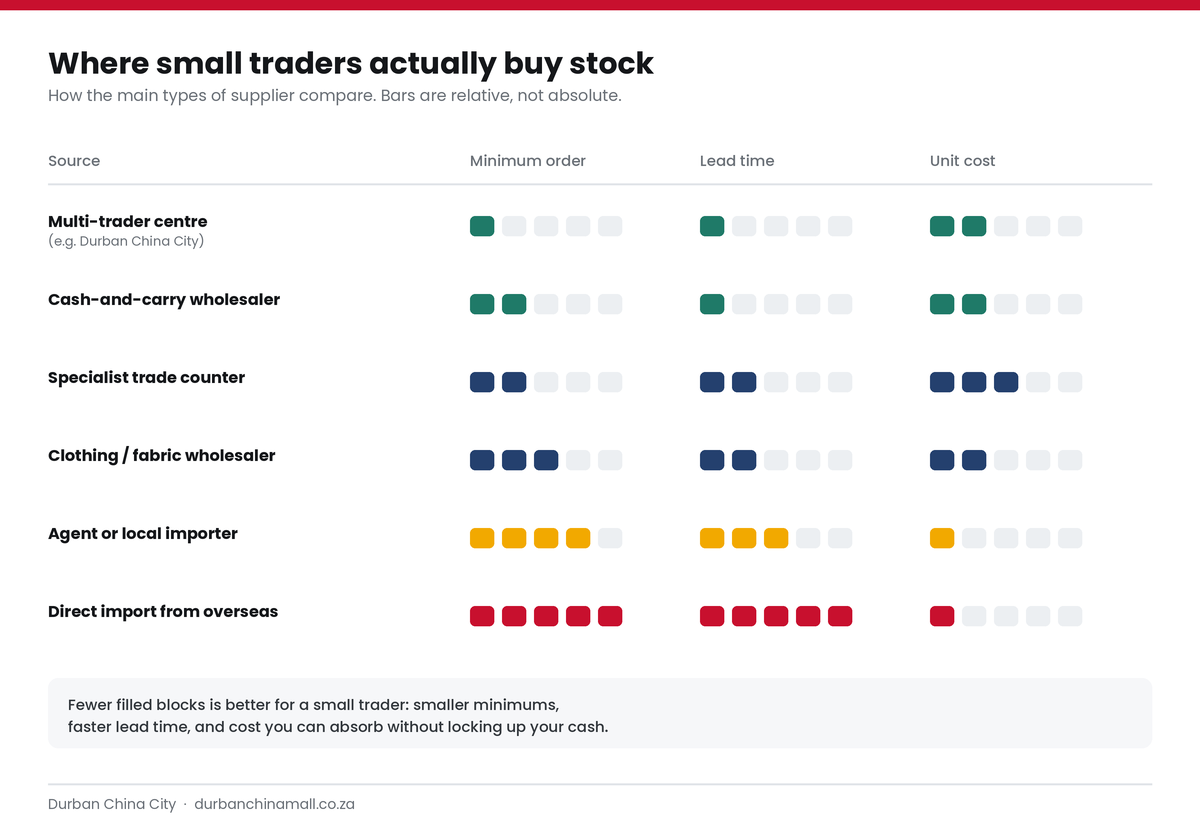
Think of these as six doors. Most small traders use two or three of them, not one.
1. Multi-trader trading centres
A trading centre is a building full of independent wholesale-and-retail units, each importing and pricing its own stock. Durban China City works this way, which is why our shop numbers run C12, E37, K16 and so on: each unit is its own business.
What this channel is genuinely good at is breadth and small quantities. You can compare five suppliers of one item in a single walk, buy a carton rather than a pallet, mix ten lines in one trip, and take it home the same day. For a trader testing what sells, that beats a slightly lower unit price on a quantity you cannot move.
What it is not is a food wholesaler or a place to put a container order. Categories run to homeware, kitchenware, decor, toys, party goods, stationery, phone accessories, luggage, hardware, cleaning supplies, clothing and fabric. Our guide to buying wholesale, minimums and carton prices covers placing an order once you are in the building.
2. Cash and carry wholesalers
Cash and carry is the grocery and FMCG channel: maize meal, rice, oil, sugar, tinned goods, cooldrink, sweets, chips, cleaning chemicals, paraffin, airtime. You walk in, load a trolley or pallet, pay and take it away, which is exactly what a spaza, tuck shop or takeaway needs.
Pricing is per case or per bale rather than per unit, margins on staples are thin and volume-driven, promotions rotate weekly, and many require trade registration to get the trade price. Some deliver within a radius, most expect you to collect. If you are stocking a shop, our spaza and tuck shop buying list is the companion piece.
3. Fabric and textile suppliers
Fabric trades on its own logic. Suppliers sell by the metre or by the roll, and the roll price per metre is meaningfully lower than the cut price. Some serve home sewers and small dressmakers; others serve manufacturers and open accounts only for volume.
Ask what the width is, whether the price is per cut metre or per roll metre, how many metres are in a roll, whether the dye lot can be matched on a repeat order, and whether they cut samples. Colour matching across dye lots catches out new curtain and uniform businesses more than anything else.
4. Clothing wholesalers
Clothing wholesale usually sells in packs rather than singles: one style in a run of sizes, often six to twelve pieces, and you rarely choose the size split. Some suppliers carry local manufacture, some import, and many carry both without saying which, so ask.
Ask about size runs, whether you can mix colours within a pack, whether faulty items can be returned, and how often new styles land. Fashion stock ages faster than any other category, so a supplier who refreshes often is worth more than one who is marginally cheaper.
5. Specialist trade counters
Electrical, plumbing, hardware, paint, glass, signage, catering equipment and packaging all have trade counters: branches that serve the public but price better for account holders in the trade. They are the right channel when an item must be compliant, correctly rated or guaranteed, which covers most things wired, plumbed or load-bearing.
Trade counters generally want an account application, a business registration, sometimes a VAT number, and a trading history before extending terms. In exchange you get technical advice, correct specifications, real warranties and stock you can reorder identically in a year.
6. Agents, importers and B2B marketplaces
Agents and importers sit between you and a factory. You buy larger quantities, usually with a deposit up front and a lead time in weeks or months. Online B2B marketplaces work similarly, with the added complication that you are judging a supplier through a screen.
It makes sense when you have proven demand, need your own branding, and can afford money sitting in transit. It is the worst possible place to start. Read buying locally versus importing from China first, for the costs, duties and risks a landed price must absorb.
If you sell X, start at Y
A starting point, not a rule. Many traders buy across two channels: the fast-moving core from one, the interesting extras from another.
| What you sell | Start with | Then add |
|---|---|---|
| Homeware, kitchenware, decor | Multi-trader trading centre | Importers once a line proves itself |
| Groceries, sweets, cooldrink, airtime | Cash and carry | Direct reps from FMCG brands |
| Curtains, nets, blinds, soft furnishing | Fabric and textile suppliers | Trading centre for rails, hooks and accessories |
| Clothing and shoes | Clothing wholesalers | Trading centre for bags, belts and accessories |
| Cleaning and hygiene services | Chemical and janitorial trade suppliers | Trading centre for buckets, mops, cloths, bins |
| Electrical, plumbing or building work | Specialist trade counters | Trading centre for consumables and hand tools |
| Party, events and decor hire | Multi-trader trading centre | Fabric suppliers for draping and covers |
| Beauty, hair and nails | Beauty and salon wholesalers | Trading centre for tools, trolleys, towels, retail lines |
| Branded or custom-specified product | Agents and importers | Local finishing and printing suppliers |
Minimum orders: what “wholesale” actually means in practice
The word wholesale means something different in each channel, and that is the biggest source of wasted trips. Broadly:
- Trading centres: the natural unit is the sealed carton, and many units will still sell you a single item at a higher price. The lowest genuine barrier to entry of any channel.
- Cash and carry: the case, the bale or the pallet. Some lines are singles, most are not.
- Fabric: cut metres for small buyers, full rolls for the real price.
- Clothing: the size-run pack, not the garment.
- Trade counters: often no minimum quantity at all, but the trade price depends on an account rather than a quantity.
- Importers and B2B: a minimum order quantity per design or colourway, frequently large enough to be a serious commitment.
Ask the minimum before you fall in love with the price. A brilliant unit price on 500 pieces of something you sell four of a week is a storeroom problem, not a bargain. Work backwards from what you can sell in a month, as set out in how to price products for resale in South Africa.
For any new line, buy the smallest quantity the supplier will sell you, even at a worse unit price, and put it in front of real customers. Those extra few rand per unit are the cheapest market research you will ever buy. Chase the volume price only once the line moves.
Credit terms, deposits and how you will actually pay
Most new traders pay up front, everywhere, for a long time. That is normal. Terms are earned, not requested.
| Channel | Usual payment reality | Terms likely later? |
|---|---|---|
| Trading centre unit | Payment on collection, arrangements vary by unit | Rarely, this is a cash-and-collect model |
| Cash and carry | Pay at the till, account customers may differ | Sometimes, with a trading history |
| Fabric supplier | Payment on collection or before cutting | Occasionally, for regular volume |
| Trade counter | Cash price at the counter, or an account | Yes, this is the normal route to 30-day terms |
| Importer or agent | Deposit up front, balance before release | Only after a long relationship |
Two practical points. Confirm accepted payment methods before you load a trolley, since arrangements differ between suppliers and even between units in one centre; our note on payments, cards and refunds covers what to check. And get a proper invoice with the supplier’s details, date, description and amount every time, for your records, returns and tax.
Delivery, collection and getting the stock home
Trading centres and cash and carries are collection-first: bring a bakkie, a trailer, a friend with a van, or budget for a courier. Trade counters and larger wholesalers more often deliver within an area, sometimes free above an order value. Importers deliver to a port or depot, and the last leg is yours.
Costs people forget: petrol both ways, tolls, someone’s time, courier or bakkie hire, straps and wrap, and the second trip because the first load did not fit. Add these before comparing two suppliers. One ten minutes away at a slightly higher price frequently beats one an hour away.
How to build a supplier list that actually works
A supplier list is an asset. Build it deliberately.
- Keep one document. Supplier name, unit or branch, contact person, phone, what they are good at, minimum order, payment methods, and the last price paid with its date. A notebook is fine.
- Record unit numbers on the spot. In a trading centre the unit number is the address. Note it as you walk, and photograph the item next to its price.
- Two suppliers per key line. One primary, one backup. Stock runs out and businesses change hands, and a line you cannot replace is a customer you lose.
- Reprice quarterly. Landed costs move with the rand and with freight, so last year’s best supplier may not be this year’s.
- Be the customer they want. Turn up when you say you will, pay on time, order predictably, and do not haggle a fair price into resentment.
- Judge on total cost, not sticker price. Reliability, consistency between orders and willingness to take back a faulty carton are worth real money.
Frequently asked questions
Frequently asked questions
Where do I buy wholesale in Durban as a small trader?
It depends on your product. Non-food general merchandise in small quantities comes from multi-trader trading centres such as Durban China City in Springfield Park. Groceries and household consumables come from cash and carry wholesalers. Fabric, clothing, electrical and plumbing each have their own specialist suppliers. Most traders end up using two or three channels.
Do I need a registered business to buy wholesale in Durban?
Not always. Trading centres and most cash and carries will sell to anyone who walks in, though a cash and carry may need registration details for a trade account price. Specialist trade counters and importers usually do want a registered business, and sometimes a VAT number, before opening an account.
What is the minimum order to buy wholesale?
It varies by channel. In a trading centre the natural unit is a sealed carton and many units will still sell single items. Cash and carries sell by the case or bale, clothing wholesalers by size-run pack, fabric suppliers by the roll for the best price, and importers set a minimum order quantity per design.
Is Durban China City a wholesaler or a retailer?
Both. Durban China City is a centre of independent units that sell single items to the public and better per-unit prices on full cartons to traders. That mix is what makes it useful for a small business testing new lines, because you can buy one to try and a carton once it sells.
Can I get credit terms from a wholesale supplier?
Sometimes, but rarely at the start. Trading centres and cash and carries generally work on payment at collection. Specialist trade counters are the usual route to 30-day terms, and they will want a registered business, an account application and a trading history first. Expect to pay up front until you have one.
How do I get my stock home from a Durban wholesaler?
Most wholesale channels are collection-first, so plan transport before you buy. A bakkie, a trailer or a hired van covers most small orders, and couriers work for lighter goods. Durban China City has on-site parking at 269 Inanda Road. Always add petrol and transport to the unit price before comparing suppliers.
Should I import directly instead of buying locally?
Only once a line has proven it sells. Importing ties up cash for weeks or months, carries duties, freight, clearing and currency risk, and requires a minimum order quantity per design. Buying locally costs more per unit but lets you test small, reorder quickly and keep your money moving.
What are Durban China City's trading hours?
Durban China City trades 09:00 to 17:00, seven days a week, at 269 Inanda Road, Springfield Park. Public holiday hours can differ, so phone 031 577 1615 before travelling. Arriving early gives you time to walk several units and compare prices before the aisles get busy.
Start with one channel and learn it properly
The mistake is sourcing from everywhere at once. Pick the channel that matches your product, learn its rhythms, build two solid supplier relationships in it, and only then add a second. Sourcing gets easier the moment you stop hunting for one magic wholesale address and start treating it as a map of doors.
Durban China City269 Inanda Road, Springfield Park, Durban, 4001
KwaZulu-Natal, South Africa
+27 31 577 1615
Open in Google Maps
Related guides
Useful next steps:
Tagged: buy wholesale durban, cash and carry durban, durban trade districts, reselling, small business stock, wholesale suppliers durban
Read next
Business Insurance for Small Traders in South Africa
The main categories of small business cover explained plainly, why the cheapest quote is usually the narrowest, and how the average clause…
Shop Security and Shrinkage: Stop Stock Loss in Your Shop
The three sources of shrinkage, why paperwork errors cost more than shoplifters, how to design staff theft out rather than police it,…
Counterfeit Goods and the Law in South Africa: Trader Guide
What counterfeit actually means, why generic and unbranded stock is different and legitimate, the due diligence to do before buying, and what…
Cheapest Courier in South Africa for a Small Business
The real delivery choices a small SA seller has, compared on cost, speed, tracking, insurance and rural coverage, plus volumetric weight, packaging…