How to Spot Quality Stock at China Mall Durban Before You Buy

Check quality by handling the item, not by looking at it. Weigh it in your hand, run a finger over seams, joints and edges, smell the plastic or fabric, check the packaging, and compare several units from the same carton rather than judging the display sample. For resale, buy unbranded or properly licensed stock only.
What this guide covers
- General principles: the five tests that work on almost anything
- Category checklists
- Textiles: bedding, curtains, towels, clothing, fabric
- Plastics: storage, houseware, buckets, toys
- Glass and ceramics
- Metal and tools
- Electricals and anything with a plug or a battery
- Cosmetics and anything applied to the body
- The inspection checklist
- Branding and the law: what resellers need to know
- Check the carton, not the display sample
- Agree what happens with damaged units before you pay
- Keep a simple quality record if you resell
- Frequently asked questions
- Inspect first, then buy with confidence
The single biggest mistake buyers make is judging an item with their eyes. Two products can look identical on a shelf and be completely different in the hand. Quality shows up in weight, in the feel of a seam, in how a lid seats, in whether a joint has any play in it, and in how the item smells when you open the bag.
The second biggest mistake is judging a carton by its display sample. The sample on the shelf is usually the best unit the trader has. Before you take forty-eight of something, look at units from inside the box, from more than one layer, and check they are consistent.
This guide is hands-on. General principles first, then a checklist per category, then what matters if you buy to resell: branding and the law, what to agree about damaged units before you pay, and how to keep a simple quality record.
General principles: the five tests that work on almost anything
- Weight. For the same size, heavier usually means more material. A pot, a pan, a lamp base, a spanner or a plate that feels unexpectedly light has had material taken out of it somewhere.
- Finish. Run a fingernail along the edges, seams and joins. Sharp flashing on plastic, rough burrs on metal, uneven glaze on ceramics and wandering stitching all point to loose manufacturing tolerances.
- Smell. A strong chemical smell in plastic, rubber, vinyl or foam is worth pausing over, especially on children’s and food-contact items. Well-cured material has very little odour.
- Packaging. Good stock usually arrives in packaging designed for it: fitted inserts, printed cartons, moisture protection where needed. Loose items rattling in a plain box have already taken knocks.
- Consistency. Pull three or four units from different parts of the carton and compare them. Matching colour, weight and finish signals a controlled production run. Visible variation means you will be sorting rejects later.
A tape measure, your phone torch, a coin for scratch-testing a hidden area, and a cloth bag to hold a sample. It takes up no space and turns guessing into checking. Ask the trader before you open, scratch or test anything, and they will almost always help you do it properly.
Category checklists
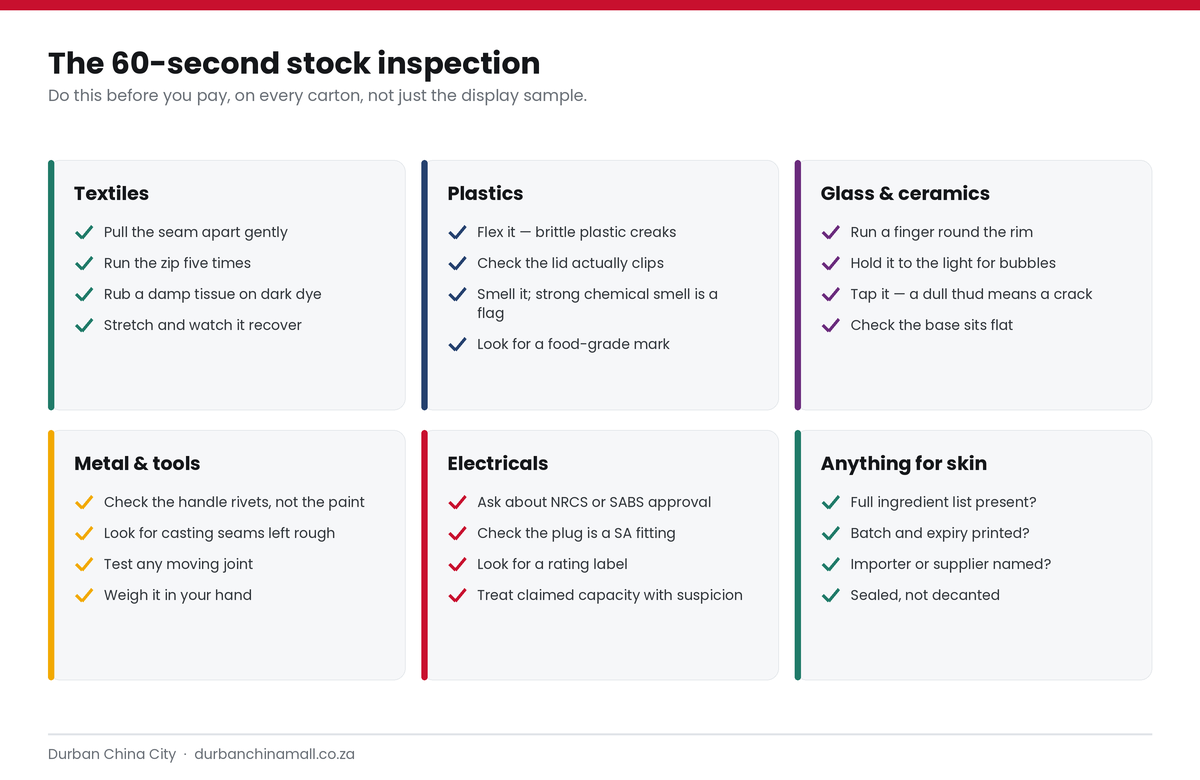
Textiles: bedding, curtains, towels, clothing, fabric
- Hold it up to the light. Even weave and no thin patches.
- Stretch a seam gently. Stitches should not gap or show loose thread ends.
- Rub a dark fabric against a white cloth or your palm to see if dye transfers.
- Check zips, poppers and elastic. Run a zip up and down five times.
- For curtains, check the drop measurement yourself rather than trusting the label.
Plastics: storage, houseware, buckets, toys
- Flex a corner. Good plastic bends and returns; brittle plastic whitens or cracks at the stress point.
- Check wall thickness at the rim and base, which is where manufacturers economise.
- Seat every lid. A lid that needs force or sits proud will not seal in daily use.
- For food storage, look for a food-grade indication and avoid anything with a strong smell.
- For children’s items, check for small parts that come away, and check cords and battery covers. Our toys guide covers child-safety checks in more detail.
Glass and ceramics
- Run a finger around the rim. It should be smooth and even, with no nicks.
- Hold glass up to the light and look for bubbles, waves and thin spots.
- Stand plates and bowls on a flat surface and check for rocking.
- Tap a ceramic piece lightly. A dull thud instead of a clear ring can indicate a hairline crack.
- Ask whether the item is dishwasher and microwave suitable, and treat decorated or metallic-trimmed pieces as hand-wash unless told otherwise.
Metal and tools
- Weight first. A light spanner or hammer is a light spanner or hammer.
- Check the jaws, flats and tips for crisp machining. Rounded edges slip and damage fasteners.
- Work every hinge, ratchet and adjuster. There should be no side-to-side play.
- Test the fit of a screwdriver in a screw head and a socket on a nut before you buy the set. See our hardware, tools and DIY guide for what to prioritise.
Electricals and anything with a plug or a battery
- Check the plug type suits South African sockets and that the pins are firmly moulded in.
- Feel the cable. Thin, stiff or overly light cable is a warning sign on anything drawing real current.
- Look for a rating plate showing voltage and wattage. No markings at all is a reason to walk away.
- Ask the trader to power the item up if that is possible at the unit.
- Ask what happens if a unit is dead on arrival, and get the answer before you pay.
Cosmetics and anything applied to the body
Treat this category more strictly than any other, because the cost of getting it wrong is not financial.
- Insist on sealed, intact packaging. No seal, no sale.
- Look for a full ingredient list, a batch number and an expiry or period-after-opening marking.
- Never buy unlabelled decanted product, and never repackage cosmetics yourself for resale.
- If you cannot establish what is in it and who is responsible for it, do not put it on a customer. The beauty, hair and nail supplies guide goes further on this.
The inspection checklist
| Check | What you are looking for | Walk away if |
|---|---|---|
| Weight in hand | Solid for its size | Noticeably lighter than a comparable item |
| Edges and seams | Smooth, even, no flashing or burrs | Sharp edges, gaping stitches |
| Moving parts | Smooth action, no play | Sticking, grinding or wobble |
| Smell | Little to no odour | Strong chemical smell, especially on children’s or food items |
| Fit and seating | Lids, caps and covers seat cleanly | Forcing required, or visible gaps |
| Markings | Ratings, materials, batch, supplier details | No markings at all on an electrical or cosmetic item |
| Carton consistency | Units match across layers | Obvious variation in colour, weight or finish |
| Branding | Unbranded, own-brand or properly licensed | You cannot establish the item is legitimately branded |
Branding and the law: what resellers need to know
This part is not about any particular shop or trader. It is about the risk you personally carry as a reseller, and it applies wherever you buy.
In South Africa, dealing in counterfeit goods is a criminal matter under the Counterfeit Goods Act. “Dealing” is broad: it covers selling, offering for sale, and having goods in your possession for the purposes of trade. Consequences can include seizure of the stock, financial penalties and prosecution, and the cost usually lands on the person holding and selling the goods, which is the small reseller.
So the practical rule for anyone buying stock to resell is simple:
- Buy unbranded or generic stock. Plain, well-made goods with no third-party trade marks carry no counterfeit risk at all, and that is the bulk of what a general merchandise centre sells.
- Buy the supplier’s own brand. A manufacturer’s own name on its own product is entirely legitimate.
- Only sell branded goods where the licensing is genuinely in order. If you cannot establish that, do not stock it, no matter how well it sells.
- Be especially careful with character prints, sports logos and film or television themes in party goods, clothing and toys. Those are licensed properties.
- Keep your invoices. Records of what you bought and from whom are useful for SARS and for showing good faith.
None of this is a reason to be nervous about buying. It is a reason to choose unbranded stock deliberately, which is usually the better commercial decision anyway. If you are unsure about a specific item or brand, take proper legal advice rather than guessing.
Check the carton, not the display sample
Ask before you open anything, then check properly. A reasonable inspection of a sealed carton takes two minutes:
- Look at the carton itself for crushing, water staining or a resealed top.
- Take one unit from the top layer, one from the middle and one from the bottom.
- Compare them for colour, weight, finish and packaging.
- Run your category checks on all three, not just the prettiest one.
- Count the units against the stated carton quantity.
- Reseal or ask the trader to reseal, and thank them for the time.
Traders are generally happy to do this with a serious buyer. Our wholesale buying guide explains carton quantities and minimums, and the bargaining guide covers how to ask for things politely.
Agree what happens with damaged units before you pay
In any bulk purchase, some units may arrive imperfect. That is normal in wholesale. What is not normal is discovering it afterwards with no arrangement in place. Before money changes hands, ask three plain questions and remember the answers:
- What do you do if a unit is broken or dead inside a sealed carton?
- Do I need to bring it back within a certain time, and do I need the slip and the packaging?
- Is the arrangement a replacement, a credit, or nothing at all?
Whatever the answer, treat it as part of the price. A stall that offers no comeback is not necessarily unreasonable; it may simply be priced that way. You just need to know before you commit. Ask for a slip on every purchase and note the unit number, which uses a letter-and-number format such as C12 or E37.
Keep a simple quality record if you resell
You do not need software. A sheet of paper or a note on your phone is enough, updated on the day you buy and again when customers respond. Over three or four trips it becomes the most valuable document in your business.
| Column | What to write |
|---|---|
| Date and unit | When you bought and from which shop number |
| Item and quantity | Description, carton size, total units |
| Cost per unit | What you actually paid per item |
| Faults out of the box | How many were unusable on arrival |
| Customer returns | How many came back, and why |
| Verdict | Buy again, buy with care, or never again |
That last column is the point. A line with a five percent return rate quietly eats your margin even if it sells well, and you will not notice without the record. Pair this with our guide on pricing products for resale so you are measuring true profit rather than turnover.
Frequently asked questions
Frequently asked questions
How do I check quality when buying wholesale?
Handle the goods rather than looking at them. Weigh an item in your hand, check edges, seams and joints, work any moving parts, smell plastics and fabrics, and look for proper markings. Then pull units from different layers of the carton and compare them, because consistency matters more than the display sample.
Can I open a carton before I buy it?
Ask first, and most traders will open it with you. A reasonable inspection means checking the carton for damage, taking units from the top, middle and bottom, comparing them, and counting the quantity. Do not open cartons yourself without permission, and offer to help reseal it afterwards.
Is it legal to resell branded goods bought at a wholesale centre?
It depends on whether the goods are legitimately branded. In South Africa, dealing in counterfeit goods is a criminal matter under the Counterfeit Goods Act, and that includes possessing them for trade. The safe route for a small reseller is unbranded, generic or supplier own-brand stock, or branded stock whose licensing you can genuinely establish.
How can I tell if something is poor quality without testing it?
Use weight, finish and smell. An item unexpectedly light for its size has had material removed somewhere. Rough edges, sharp mould flashing, uneven glaze or loose stitching show weak manufacturing control. A strong chemical odour suggests poorly cured material. One of those is a caution; two together is a decision.
What should I do about damaged items in a bulk order?
Agree the arrangement before you pay. Ask what happens if a unit is broken or dead inside a sealed carton, whether you must return it within a set time, and whether the outcome is a replacement, a credit or nothing. Keep the slip and the packaging, and note the shop number so you can go back to the right unit.
Do cheaper items always mean lower quality?
No, but they often move together. A low price can reflect a large import volume, an older consignment or thin trader margins. It can also reflect thinner material and weaker assembly. The only way to tell is to inspect the item, which is why the hand tests matter more than the price tag.
What should I check on electrical items?
Check the plug fits South African sockets and that the pins are firmly moulded in, feel the cable thickness, and look for a rating plate showing voltage and wattage. Ask the trader to power the item up if possible, and check that battery covers screw down. An electrical item with no markings at all is not worth the risk.
Inspect first, then buy with confidence
Good buying is a habit, not a talent. Pick the item up, run the five tests, check inside the carton, agree what happens if something is broken, and write down how the line performed. Do that for three trips and you will buy better than people who have shopped here for years.
Durban China City269 Inanda Road, Springfield Park, Durban, 4001
KwaZulu-Natal, South Africa
+27 31 577 1615
Open in Google Maps
Tagged: china mall durban, counterfeit goods act, how to check quality, product inspection, reselling south africa, wholesale buying tips
Read next
How to Price Products to Sell More: Pricing Psychology
Anchoring, charm pricing, bundles, round numbers for cash, and raising prices without losing regulars, with a clear line between effects that hold…

How to Bargain at China Mall Durban Without Being Rude
A respectful, practical guide to haggling at China Mall Durban: when it is appropriate, the phrases that work, what discount to realistically…

China Mall Durban Prices: What Things Typically Cost
Typical price ranges at Durban China City by category, why two stalls charge different prices, how carton pricing works, and how to…