How to Register a Business in South Africa: CIPC Guide
In South Africa you may trade legally as a sole proprietor without registering a company, but you must still declare the income to SARS. Registering a private company with CIPC creates a separate legal entity with its own name, letting you open a business bank account, invoice larger customers and tender. Requirements change, so confirm with CIPC and SARS.
What this guide covers
- Trading without registering: when it is fine, and when it stops being fine
- Sole proprietor, partnership or Pty Ltd: what actually differs
- What CIPC registration actually gives you
- SARS: income tax, and VAT above a threshold
- Employing people: UIF, PAYE and the rest
- B-BBEE affidavits, licensing and zoning
- Record keeping: the part that decides whether any of this works
- Frequently asked questions
- Do it in the right order
- Related guides
You can start trading in South Africa today without registering anything. If you buy stock and sell it under your own name you are a sole proprietor, and that is a legal way to do business. What you cannot skip is declaring the income to SARS, because the profit is part of your personal taxable income either way.
Registration becomes necessary the moment you need to be legally separate from yourself: to trade under a company name, to open a business bank account in that name, to invoice corporates or government, to tender, or to limit your personal liability. That registration happens through the Companies and Intellectual Property Commission, CIPC.
This guide walks through the picture in general terms. Please take the caveat below seriously: none of this is legal, accounting or tax advice, and every fee, threshold, form and timeframe in this area changes. Confirm the current position with CIPC, SARS, your bank and your municipality before acting.
This article explains how business registration in South Africa generally works. It is not legal, tax or accounting advice, and it deliberately quotes no fees, thresholds or turnaround times, because those change. Confirm anything you rely on with CIPC, SARS, your municipality, your bank or a registered accountant or attorney.
Trading without registering: when it is fine, and when it stops being fine
A sole proprietor is simply a person trading. There is no separate entity, no registration number, no annual return to CIPC. You and the business are the same in law, so the profits are yours and so are the debts.
For a trader buying a few cartons and selling at a market or on WhatsApp, this is usually the right start. It costs nothing, the admin is light, and you can register later without losing anything you have built. Our guide to starting a reselling business with R1,000 assumes this position.
It stops being enough when any of the following becomes true:
- A customer will only buy from a registered entity, common with corporates, schools, retailers and tenders.
- You want a bank account in the business name rather than your own.
- You want to trade under a protected name that is yours.
- The business carries real risk, such as stock on credit, staff, a lease or contracts, and you want that separated from your house and savings.
- You want to bring in a partner or shareholder properly.
- A supplier or landlord wants a registration number to open an account.
None of those are legal thresholds; they are practical signals. The legal position is that trading as a sole proprietor is allowed, and the tax position is that the income is declarable either way.
Sole proprietor, partnership or Pty Ltd: what actually differs
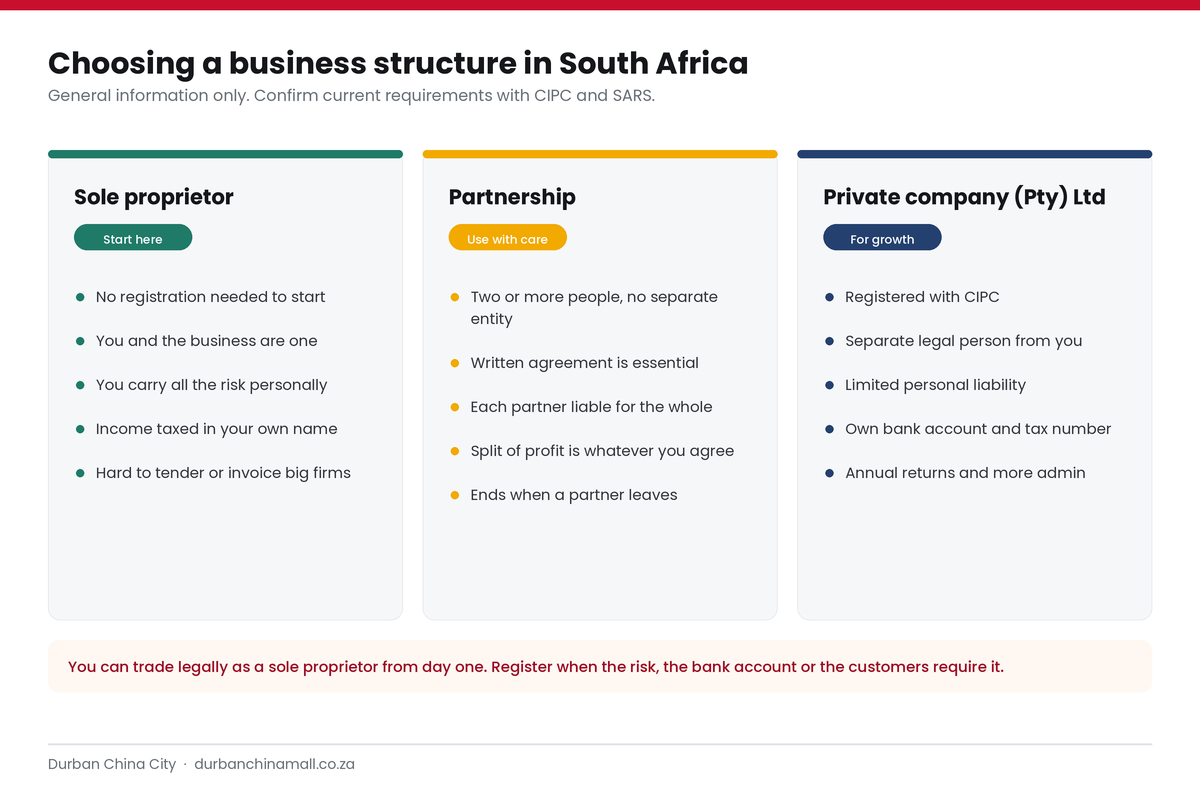
Most small South African businesses end up in one of three shapes. The table compares them generally; the right answer for you needs a conversation with an accountant.
| Feature | Sole proprietor | Partnership | Private company (Pty Ltd) |
|---|---|---|---|
| Separate legal entity | No | No | Yes |
| CIPC registration | Not required | Not required | Required |
| Liability for debts | Personal and unlimited | Personal, and generally shared | Generally limited to the company, with exceptions |
| Owners | One person | Two or more people | One or more shareholders |
| How profit is taxed | As the owner’s personal income | In each partner’s personal hands | The company is taxed, then distributions to owners |
| Business bank account in a business name | Usually not | Sometimes, bank dependent | Yes |
| Ongoing compliance | Lightest | Light, but a written agreement matters | Annual returns and financial records required |
| Ease of adding an owner or selling | Difficult | Difficult | Straightforward through shares |
| Typical fit | Testing an idea, side trading | Two people, shared capital, high trust | Growth, contracts, staff, tendering |
A partnership deserves one warning. Because it is not a separate entity, each partner can generally be held responsible for the whole of the partnership’s debts, not just their share. If you go this route, put a written agreement in place covering contributions, profit split, decision making and what happens when someone wants out, and have it checked properly.
What CIPC registration actually gives you
Registering a private company with CIPC does several distinct things:
- A separate legal person. The company can own things, owe things, sign contracts and be sued in its own name. Personal liability is generally limited, though directors can still be held responsible in defined circumstances such as reckless trading or personal surety.
- A registered company name. Name reservation happens through CIPC. A registered company name is not the same as a registered trade mark, which is a separate process.
- A registration number. The number suppliers, banks, landlords and procurement departments ask for.
- A business bank account. Banks will open an account in the company name once you have the registration documents.
- The ability to invoice larger customers and tender. Most corporate and government procurement requires a registered entity, tax compliance and supplier registration.
- Continuity. The company survives changes in ownership.
The broad steps of registering a private company
The process is run by CIPC and is largely online. Broadly it involves:
- Creating a customer profile on the CIPC system and verifying your identity.
- Applying for a name reservation, or registering with the registration number as the name and adding a trading name later.
- Submitting the registration application with directors’ and incorporators’ details, including identity documents.
- Paying the applicable fees.
- Receiving the registration documents, including the Memorandum of Incorporation.
- Attending to follow-on registrations: SARS, a bank account, and anything specific to your trade.
Fees, documents required, screens and turnaround times all change. Confirm the current process and cost with CIPC directly rather than relying on any third-party summary, including this one. Agents will register a company for you for a service fee, which is legitimate but optional.
SARS: income tax, and VAT above a threshold
CIPC registration and SARS registration are separate things. Broadly:
- Income tax. A registered company is a taxpayer in its own right. A sole proprietor declares business profit in their personal return. Either way the income must be declared.
- Provisional tax. Businesses and individuals with income outside a salary generally submit provisional returns during the year rather than paying only at year end. Whether it applies to you is a SARS question.
- VAT. VAT registration becomes compulsory once taxable turnover exceeds a threshold set by SARS over a twelve-month period, and voluntary registration is possible above a lower level. The thresholds, the VAT rate and the rules change. Confirm the current position with SARS before assuming anything.
- Tax compliance status. Larger customers and tenders usually want proof of tax compliance, obtained through SARS.
Think about VAT before you are forced into it. Once registered you charge VAT on sales, claim it on qualifying purchases and submit returns on a cycle. That helps if your customers are VAT-registered businesses and complicates things if they are ordinary consumers. Factor it into your pricing, as covered in how to price products for resale in South Africa.
The single biggest admin favour you can do yourself is to stop mixing personal and business money. Even as an unregistered sole proprietor, use a separate account purely for the business. It makes your tax return honest, your record keeping simple and your profit visible. Ask your bank what they need, since requirements differ by bank and by structure.
Employing people: UIF, PAYE and the rest
The moment you have an employee rather than a genuinely independent contractor, a second layer of obligations begins:
- PAYE. Above the level at which employees’ tax must be deducted, you register as an employer with SARS, deduct PAYE from salaries and pay it over on the required cycle.
- UIF. Unemployment Insurance Fund contributions are generally required for qualifying employees, from both employer and employee, with regular declarations.
- Skills development levy. Applies to employers above a payroll level set in law.
- Compensation fund. Registration for workplace injury cover is generally required of employers.
- Basic conditions of employment. Contracts, hours, leave, notice and the national minimum wage all apply, through the Department of Employment and Labour.
Rates, thresholds and deadlines in all of the above change. Confirm each with SARS and the Department of Employment and Labour, and get a bookkeeper or payroll service involved before your first payday, not after it.
B-BBEE affidavits, licensing and zoning
B-BBEE for small businesses
Businesses below a turnover level defined in the B-BBEE codes can generally confirm their status by sworn affidavit rather than a full verification, and larger customers frequently ask for it. The turnover bands, format and rules change, so use the current official template. A commissioner of oaths must commission the affidavit.
Municipal business licences and zoning
Whether you need a municipal business licence depends on what you do and where. Activities involving the preparation or sale of food, health and body treatments, and some entertainment generally require a licence from the local municipality. Trading in a public place, running a stall or operating from a vehicle usually needs its own permission.
Zoning is the other half. Trading from a residential property is subject to your municipality’s town planning scheme, which may allow it within limits, require consent, or not allow it. Signage, parking, noise and customer traffic all come into it, and processes differ between municipalities, so confirm before you sign a lease or convert a garage. If you plan to trade at markets, our guide to getting a stall at KZN flea and craft markets covers what organisers ask for.
Record keeping: the part that decides whether any of this works
Registration is a day’s admin. Records are forever, and they are what keep you out of trouble and tell you whether you are making money.
- Keep every supplier invoice. Not a smudged till slip, but a proper invoice with the supplier’s details, date, description and amount. Ask at the counter, every time.
- Issue numbered invoices. Sequential, dated, with your details and the customer’s. VAT-registered businesses must meet specific content requirements set by SARS.
- Separate the money. Business account in, business account out.
- Record stock. What you bought, what it cost, what remains. Without it you cannot calculate real profit.
- Retain documents. South African law requires records to be kept for a set period. Confirm the current retention period with SARS and CIPC, and keep digital copies as well as paper.
- Reconcile monthly. An hour a month beats a lost weekend in February.
If you buy wholesale and resell, pair this with our guide to where to buy wholesale in Durban. Supplier invoices are the raw material of your records as much as your stock is.
Frequently asked questions
Frequently asked questions
Do I need to register a business to sell in South Africa?
Not necessarily. You may trade as a sole proprietor under your own name without registering an entity, and that is legal. You must still declare the income to SARS. Registration with CIPC becomes necessary when you need a company name, a business bank account, limited liability, or to invoice corporate and government customers.
What does CIPC registration give me?
It creates a separate legal entity with its own registration number and name. That entity can open a bank account, sign contracts, employ people and tender. It also generally limits your personal liability, although directors can still be held responsible in certain circumstances. Confirm the current requirements and fees with CIPC.
How much does it cost to register a company in South Africa?
CIPC fees change, so check the current amounts on the CIPC’s own channels rather than relying on figures quoted elsewhere. Costs typically include name reservation and the registration itself, with optional extra service fees if you use an agent. Budget separately for a bank account, an accountant and any licences you need.
What is the difference between a sole proprietor and a Pty Ltd?
A sole proprietor is a person trading, with no separate entity, so business debts are personal debts and profit is taxed as personal income. A private company is a separate legal person registered with CIPC, taxed in its own right, with liability generally limited to the company and ongoing compliance obligations.
When must I register for VAT in South Africa?
VAT registration becomes compulsory once your taxable turnover exceeds the threshold SARS sets over a twelve-month period, with voluntary registration possible above a lower level. Thresholds and rules change, so confirm the current position with SARS. Consider the effect on your pricing before registering voluntarily.
Do I need a business bank account?
It is not always legally required, but it is strongly advisable. Separating business and personal money makes tax returns accurate, record keeping simple and profit visible. A registered company will generally need an account in the company name. Ask your bank which documents they require, as this differs between banks.
Do I need a licence to run a business from home?
It depends on the activity and your municipality’s zoning scheme. Some activities, particularly food handling and personal care services, generally require a municipal business licence. Home-based trading may be permitted within limits, may need consent, or may not be allowed. Confirm with your local municipality before committing.
What is a B-BBEE affidavit and do I need one?
It is a sworn statement that small businesses below a turnover level defined in the B-BBEE codes can use to confirm their status instead of a full verification. Larger customers often request it. Bands, templates and rules change, so use the current official format and have it commissioned by a commissioner of oaths.
Do it in the right order
Start trading, prove people buy from you, keep clean records from day one, and register when the business asks you to rather than because it feels official. When you register, deal with CIPC, SARS, your bank and your municipality directly, confirm every current figure with them, and get an accountant involved before you have a problem instead of after.
Durban China City269 Inanda Road, Springfield Park, Durban, 4001
KwaZulu-Natal, South Africa
+27 31 577 1615
Open in Google Maps
Related guides
Next steps for a new trader:
Tagged: cipc registration, pty ltd, register a business south africa, sars registration, small business south africa, sole proprietor
Read next
Business Insurance for Small Traders in South Africa
The main categories of small business cover explained plainly, why the cheapest quote is usually the narrowest, and how the average clause…
Shop Security and Shrinkage: Stop Stock Loss in Your Shop
The three sources of shrinkage, why paperwork errors cost more than shoplifters, how to design staff theft out rather than police it,…
Counterfeit Goods and the Law in South Africa: Trader Guide
What counterfeit actually means, why generic and unbranded stock is different and legitimate, the due diligence to do before buying, and what…
Cheapest Courier in South Africa for a Small Business
The real delivery choices a small SA seller has, compared on cost, speed, tracking, insurance and rural coverage, plus volumetric weight, packaging…